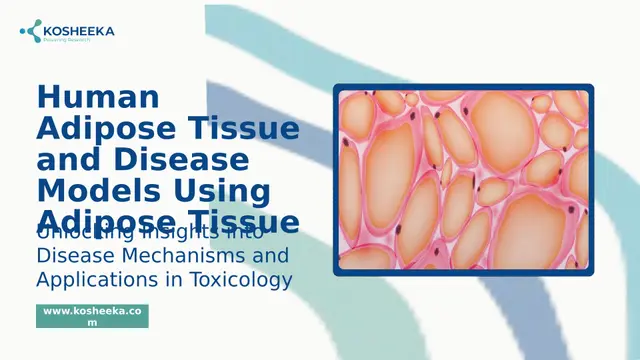
Human Adipose Tissue and Disease Models Using Adipose Tissue
PPTXAbout this presentation
Human adipose tissue serves as a valuable resource for studying disease mechanisms, offering diverse applications in toxicology and pharmacology. It plays a critical role in modeling chronic diseases like obesity and diabetes, aided by advancements such as organ-on-chip technology and 3D bioprinting. Adipose-derived stem cells are pivotal in regenerative medicine, while models are used extensively for drug screening, studying toxicants, and evaluating endocrine disruptors. Despite challenges...
- Category
- Research & Analytics
- Uploaded
- Format
- PPTX
Transcript
Open full transcript
Human
Adipose Tissue
and Disease
Models Using
AUndlocikpinog sInesig Thtsi sinstou e
Disease Mechanisms and
Applications in Toxicology
www.kosheeka.co
m
Introduction to Human
A•dDiepfionitsioen : TSpiescsiaulizeed connective
tissue storing energy as fat.
• Types: White, brown, and beige
adipose tissues.
• Key Functions:
⚬ Energy storage
⚬ Endocrine functions (e.g.,
leptin, adiponectin secretion) Source image :-
https://www.researchgate.net/figure/Three-types-of-adipocytes-The-morphological-
⚬ Insulation and cushioning differences-between-the-three-types-of_fig2_324476714
organs
Importance of Adipose
Tissue in Research
• Source of primary cells: Adipocytes,
preadipocytes, and stromal vascular
fractions (SVFs).
• Accessibility and abundance: Easily
obtained through liposuction or
biopsy.
• Versatility in applications: Studies of
Source image : - https://www.invitra.com/en/carboxytherapy-for-stretch-
metabolic disorders, inflammation, marks/cells/
and tissue engineering.
Adipose Tissue as a
D•iRseeleavasncee tMo cohrdoneic ldiseases:
⚬ Obesity and metabolic syndromes
⚬ Diabetes (insulin resistance studies)
⚬ Cardiovascular diseases
• Applications in inflammation and
immune system dysregulation research
image Source: https://link.springer.com/article/10.1007/s10561-021-09905-z/figures/2
Adipose Tissue-Derived Stem
Cells (ADSCs)
• Characteristics:
⚬ Multipotent, capable of
differentiating into adipocytes,
osteoblasts, chondrocytes, etc.
• Use in regenerative medicine:
⚬ Wound healing
⚬ Bone and cartilage repair
⚬ Anti-aging therapies
Image Source:- https://www.researchgate.net/figure/Pathological-adipose-tissue-
endocrine-signals-Adipose-tissue-synthesizes-and-delivery-a_fig2_355765117
Advances in Adipose Tissue
DParit I• Osrgeana-ons-Cehi pM Tecohndoloegyl:s
⚬ Microfluidic platforms that simulate the structure and function of human adipose tissue.
⚬ Allows precise control of the microenvironment, enabling the study of adipose tissue interactions with
other organ systems like the liver (liver-adipose co-culture chips).
⚬ Useful in studying dynamic processes like lipid metabolism, drug response, and inflammation.
Part II
• 3D Bioprinting and Tissue Engineering:
⚬ Using adipose-derived cells to create 3D tissue constructs for in vitro modeling.
⚬ Enables the development of adipose tissue analogs with physiological properties, such as vascularization
and ECM deposition.
⚬ Applications include studying fibrosis, insulin resistance, and tissue regeneration.
Part III
• Co-culture Models:
⚬ Integration of adipocytes with immune cells, endothelial cells, or cancer cells to study cross-talk.
• Examples:
⚬ Adipocyte-macrophage interactions in chronic inflammation and obesity.
⚬ Adipocyte-cancer cell interactions in tumor microenvironments.
⚬ Advances understanding of complex systems like inflammation-driven insulin resistance or tumor growth.
Applications in Toxicology and
PPahrt aI rmacology
• Drug Screening:
⚬ Adipose tissue models are widely used to evaluate drug effects on adipogenesis, lipolysis, and
inflammation.
⚬ Enables identification of off-target effects, such as adipotoxicity or altered endocrine signaling.
⚬ Particularly important for metabolic drugs like anti-diabetics and anti-obesity medications.
Part II
• Environmental Toxicants:
⚬ Adipose tissue acts as a depot for lipophilic toxicants (e.g., pesticides, dioxins).
⚬ Models are used to study the long-term storage and release of toxicants, along with their
effects on lipid metabolism and inflammation.
⚬ Helps assess the impact of environmental pollution on metabolic health.
Part III
• Endocrine Disruptors:
⚬ Adipose tissue models enable studying compounds that interfere with hormonal pathways
(e.g., BPA, phthalates).
⚬ Focus on evaluating their effects on adipocyte differentiation, insulin signaling, and lipid
storage.
⚬ Critical for understanding links between environmental exposures and diseases like obesity or
diabetes.
Challenges and
L•imHeitearotgieonneisty in adipose tissue sources.
• Maintaining physiological relevance in
vitro.
• Long-term culture viability.
• Cost and scalability for large-scale
applications.
Conclusion and Call to
A•cAtdiipoonse tissue’s is playing a tremendous role in disease
modeling and translational applications.
• Call for interdisciplinary collaboration to overcome
challenges.
• Let us harness the untapped potential of human adipose
tissue to revolutionize biomedical research.
Contact us
www.kosheeka.com +91-9654321400
[email protected] A-102, Sector-5 Noida-
201301, India
Comments
View comments
Add a comment