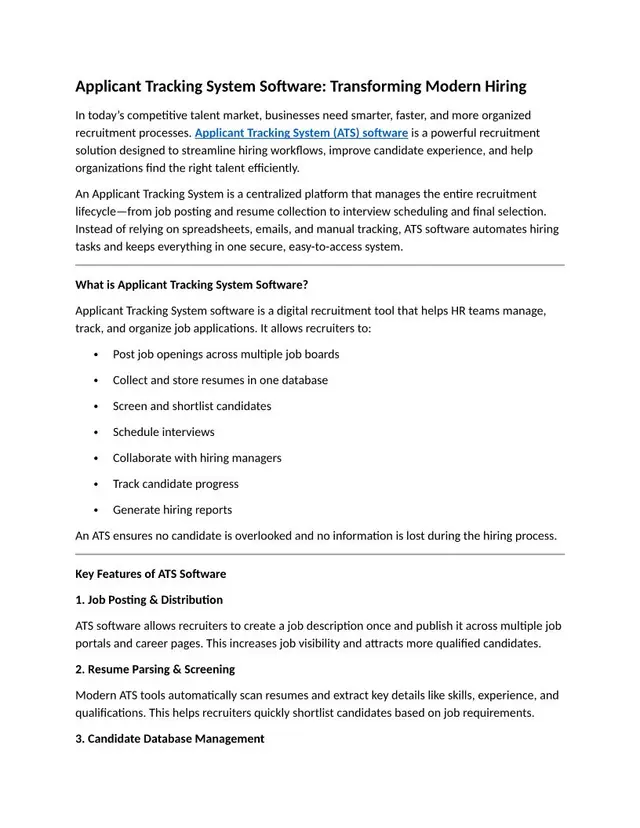
Applicant Tracking System Software
DOCXAbout this presentation
In today’s competitive talent market, businesses need smarter, faster, and more organized recruitment processes. Applicant Tracking System (ATS) software is a powerful recruitment solution designed to streamline hiring workflows, improve candidate experience, and help organizations find the right talent efficiently.
- Category
- Technology
- Uploaded
- Format
- DOCX
Transcript
Open full transcript
Applicant Tracking System Software: Transforming Modern Hiring In today’s competitive talent market, businesses need smarter, faster, and more organized recruitment processes. Applicant Tracking System (ATS) software is a powerful recruitment solution designed to streamline hiring workflows, improve candidate experience, and help organizations find the right talent efficiently. An Applicant Tracking System is a centralized platform that manages the entire recruitment lifecycle—from job posting and resume collection to interview scheduling and final selection. Instead of relying on spreadsheets, emails, and manual tracking, ATS software automates hiring tasks and keeps everything in one secure, easy-to-access system. What is Applicant Tracking System Software? Applicant Tracking System software is a digital recruitment tool that helps HR teams manage, track, and organize job applications. It allows recruiters to: Post job openings across multiple job boards Collect and store resumes in one database Screen and shortlist candidates Schedule interviews Collaborate with hiring managers Track candidate progress Generate hiring reports An ATS ensures no candidate is overlooked and no information is lost during the hiring process. Key Features of ATS Software 1. Job Posting & Distribution ATS software allows recruiters to create a job description once and publish it across multiple job portals and career pages. This increases job visibility and attracts more qualified candidates. 2. Resume Parsing & Screening Modern ATS tools automatically scan resumes and extract key details like skills, experience, and qualifications. This helps recruiters quickly shortlist candidates based on job requirements. 3. Candidate Database Management All applicant information is stored in a searchable database. Recruiters can filter candidates by skills, location, experience, and other criteria. 4. Workflow Automation Automated workflows move candidates through different hiring stages—application review, screening, interview, offer, and onboarding—saving time and reducing manual work. 5. Interview Scheduling ATS software simplifies interview coordination by integrating calendars and sending automated notifications to candidates and hiring managers. 6. Reporting & Analytics Recruiters can generate detailed hiring reports, including: Time-to-hire Cost-per-hire Source of hire Candidate conversion rates These insights help organizations improve recruitment strategies. 7. Collaboration Tools Hiring managers can review resumes, leave comments, rate candidates, and make decisions within the system, improving teamwork and transparency. Benefits of Using Applicant Tracking System Software Faster Hiring Process Automation reduces manual tasks, helping recruiters screen and shortlist candidates quickly. Improved Candidate Experience Automated updates, timely communication, and smooth interview scheduling create a professional experience for applicants. Better Quality of Hire Advanced filtering and screening tools help match candidates more accurately to job roles. Centralized Recruitment Data All candidate data is stored in one place, making tracking and reporting easier. Compliance & Data Security ATS platforms maintain organized records and ensure compliance with hiring regulations. Why Businesses Need ATS Software Recruitment today involves handling hundreds or even thousands of applications for a single role. Without an ATS, managing this volume becomes overwhelming and inefficient. An Applicant Tracking System ensures structured hiring processes, reduces errors, and improves productivity. Small businesses benefit by saving time and resources, while large enterprises gain scalability and detailed analytics to manage high-volume hiring. How ATS Software Supports HR Teams Eliminates manual resume sorting Reduces repetitive administrative tasks Enhances communication with candidates Tracks recruitment KPIs Helps build a long-term talent pipeline By automating routine tasks, HR teams can focus more on strategic decision-making and talent engagement. Choosing the Right ATS Software When selecting an Applicant Tracking System, consider: Ease of use Customizable workflows Integration with job boards and HR tools Mobile accessibility Reporting capabilities Scalability for future growth A good ATS should align with your hiring goals and organizational needs. The Future of Applicant Tracking Systems Modern ATS platforms are evolving with AI-powered capabilities. Advanced systems now offer: AI-based resume matching Predictive hiring analytics Automated candidate scoring Chatbots for candidate communication These innovations make hiring smarter, data-driven, and more efficient. Conclusion Applicant Tracking System software has become an essential tool for modern recruitment. It simplifies hiring, enhances collaboration, improves candidate experience, and provides valuable insights through analytics. Whether you are a startup or a large enterprise, investing in the right ATS software can significantly improve your hiring outcomes. By leveraging automation, intelligent screening, and centralized data management, organizations can attract top talent faster and build a stronger workforce for long-term success.
Comments
View comments
Add a comment