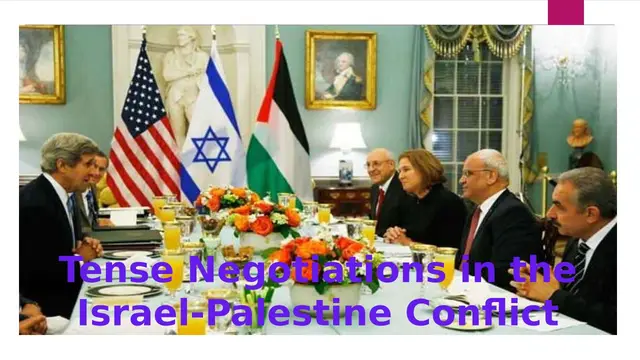
Tense Negotiations in the Israel-Palestine Conflict
PPTXAbout this presentation
Tense negotiations continue in the Israel-Palestine conflict. Will there be a breakthrough? Stay informed on this critical issue. #IsraelPalestine #PeaceTalks #WorldNews
- Category
- News & Politics
- Uploaded
- Format
- PPTX
Transcript
Open full transcript
Tense Negotiations in the Israel-Palestine Conflict Introduction: The conflict between Israel and Palestine has been characterized by years of hostility, bloodshed, and difficult diplomatic attempts. The following are some current occurrences. Source: Foxnews.com Current Diplomatic Discussions: Senior representatives from the United States, Israel, Palestine, Jordan, Egypt, and Egypt convened in Aqaba, Jordan, in March 2023, reiterating their commitment to upholding earlier accords and pursuing a fair and enduring peace. The same parties attended a similar session on March 19, 2023, in Sharm el-Sheikh, Egypt. Source: Arabic.cnn.com Discussions between Israelis and Palestinians: These represented the first direct discussions between Israelis and Palestinians in a long time. At these meetings, agreements were made to maintain the status quo at Jerusalem's holy sites, halt unilateral actions, and defuse the current violent situation on the ground. Source: blog.gale.com Obstacles and Growing Phraseology: Tensions have increased as a result of Israel's approval of nine settlement outposts and its decision to revoke a portion of the 2005 Disengagement Law, which required Israeli settlers to leave certain areas of the occupied West Bank. The ongoing demolition and confiscation of buildings owned by Palestinians exacerbates the conflict Source: vox.com Statements Regarding the Two- State Solution: Both Israeli and Palestinian leaders expressed their strong support for the two-state solution during the seventy- seventh session of the General Assembly. However, there hasn't been much progress made in carrying out resolution 2334 (2016), which demands an end to settlement activity in the Occupied Palestinian Territory. Source: nytimes.com Recent Developments: Israel began airstrikes in eastern Rafah on May 10, 2024, and the ceasefire negotiations in Cairo came to an impasse. Regarding the cease-fire negotiations, Hamas declared that the "ball is completely" in Israel's hands. Hope for Peace: There is still some hope for peace in Gaza even after Israel rejected the most recent ceasefire proposals. Israel demands a more Source: theuniverse.com thorough agreement that takes its security concerns into account History of conflict : On 19th century during the rise of national movements, including Zionism and Arab nationalism. Zionism sought to establish a homeland for the Jewish people in Palestine, which was then part of the Ottoman Empire. Balfour Declaration (1917): The British government issued the Balfour Declaration, supporting the establishment of a “national home for the Jewish people” in Palestine. Source: shutterstock.com This led to increased Jewish immigration to the region. Post World War II: In 1948, the State of Israel was declared, leading to the first Arab-Israeli war and the displacement of hundreds of thousands of Palestinians, an event referred to by Palestinians as the Nakba or "Catastrophe". UN Partition Plan (1947): The United Nations proposed a plan to partition Palestine into separate Jewish and Arab states, with Jerusalem as an international city. The plan was accepted by Source: iofc.org Jewish leaders but rejected by Arab leaders. Six-Day War (1967): Israel captured the West Bank, Gaza Strip, and East Jerusalem during the Six-Day War, territories that are still at the center of the conflict today. Oslo Accords (1990s): The 1990s saw a significant peace process, resulting in the Oslo Accords, which established the Palestinian Authority and set a framework for future negotiations. Source: shutterstock.com Conclusion: Despite various rounds of peace talks and international mediation, the conflict has persisted with cycles of violence and temporary ceasefires. Issues such as Israeli settlements, the status of Jerusalem, Palestinian statehood, and the right of return for Palestinian refugees remain contentious. Source: chanakyaforum.com
Comments
View comments
Add a comment